
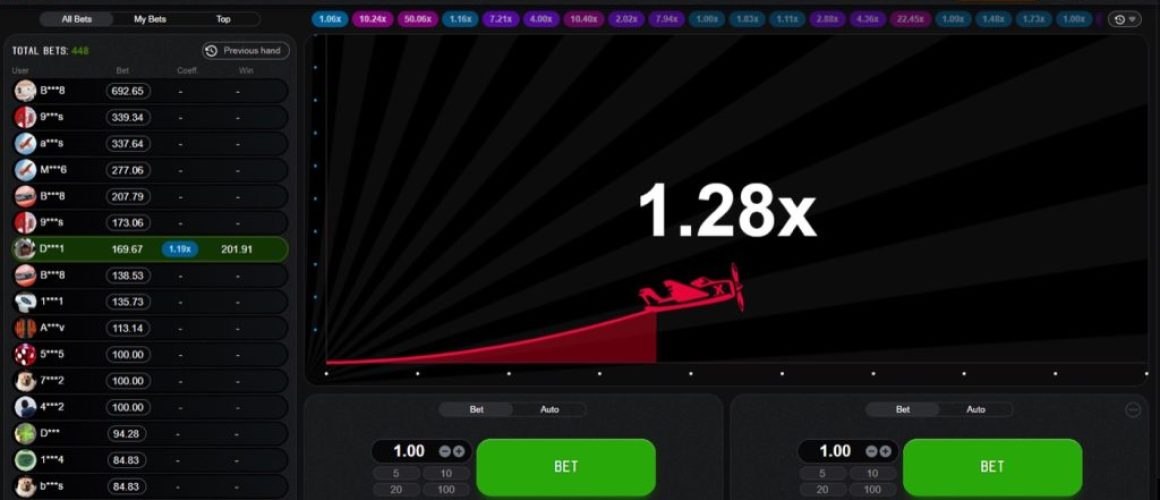
Aviator Auto-Bet Risks Explained Explained
Aviator is a crash game by Spribe. Each round shows an increasing curve, and the round ends when the plane crashes.
Auto-bet can place bets for 10-100 rounds. Stop-on-loss can stop the sequence after a loss limit. Neither setting changes the crash point, the 97% RTP or the 3% house edge.
What Auto-Bet Does
Aviator offers Auto Bet and Auto Play for 10-100 rounds. The feature repeats a preset betting action without requiring a manual click before every round.
The game has two bet panels per round. Each panel can use a separate cash-out target, so automation can repeat one target or run two different targets.
Auto-bet changes the pace of play. It does not create a new betting result. The crash point is fixed before take-off, and the server publishes a SHA-256 hash before each round. Player client seeds are combined with the server seed, and the inputs can be checked after the round with the verification tool inside the game.
- Auto Bet repeats a stake and cash-out instruction.
- Auto Play runs the instruction for a selected number of rounds.
- Auto Cash-Out uses a preset multiplier.
- Stop-on-win and stop-on-loss can end the sequence.
A 10-round sequence may feel controlled because it has a clear endpoint. A 100-round sequence creates more bets and more exposure. The setting controls the number of attempts, not the mathematical return from each attempt.
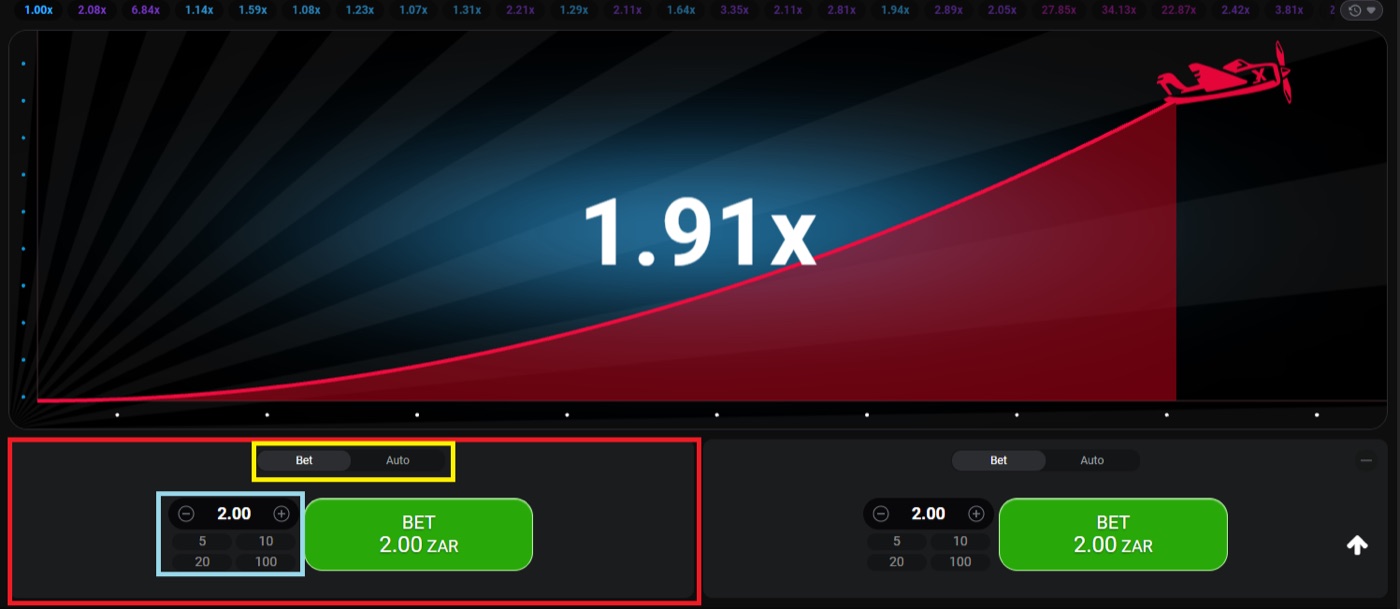
Aviator can run two separate bet panels with separate cash-outs.
10-100 Round Exposure
Aviator Auto Play runs between 10 and 100 rounds. A 100-round setting can therefore place ten times as many bets as a 10-round setting when the same stake is used.
Consider a $1 stake. Ten automated rounds put $10 through the sequence if every round places one bet. One hundred rounds put $100 through the sequence. The amount at risk rises because the number of bets rises.
The result is not determined by the number alone. About 3% of rounds crash instantly at 1.00x, or roughly 1 in 33 rounds. Other rounds can reach different multipliers, but each round remains independent.
| Setting | $1 stake per round | What it changes |
|---|---|---|
| 10 rounds | $10 in scheduled stakes | Shorter exposure |
| 50 rounds | $50 in scheduled stakes | More repeated bets |
| 100 rounds | $100 in scheduled stakes | Longest listed exposure |
The dollar totals above describe scheduled stakes before wins and cash-outs are counted. A win can return money, while a loss removes the stake. The table does not predict the final balance.
- A longer sequence gives more chances to encounter an instant 1.00x crash.
- A longer sequence also gives more chances to reach a selected cash-out target.
- Those two outcomes do not cancel the house edge.
- More rounds can make normal variance look like a pattern.
At 1.5x, the probability that a round reaches the multiplier is 64.7%. At 2x, it is 48.5%. The lower target wins more often, but the expected value at every cash-out target remains -3% of the stake.
Automation can also remove a natural pause. A player who would stop after one manual loss may let Auto Play continue. That is a behavioural risk, not a change to the game rules.
Stop-On-Loss Limits
Aviator includes stop-on-loss for Auto Bet and Auto Play. The setting can stop an automated sequence after the configured loss condition is reached.
Stop-on-loss limits the planned session. It does not make a losing sequence recoverable, and it does not change the probability of the next round.
Suppose a player starts with a $20 session limit and uses $1 stakes. A stop-on-loss rule may end the automated sequence after the selected loss amount is reached. The player still loses that amount when the rule activates. The setting limits further scheduled bets; it does not refund earlier ones.
- A stop-on-loss rule can prevent the remaining rounds from running.
- It cannot change a round that has already crashed.
- It cannot make a later round reach 1.5x, 2x or another target.
- It cannot turn a negative expected value into a positive one.
The same point applies to stop-on-win. A winning stop can end a session at a chosen result, but the completed bets still had the same probabilities. A stop rule is a boundary for play, not an advantage over the house.
Loss limits matter because Aviator rounds last about 8-30 seconds, with 60-90 rounds possible in an hour. Automation can therefore use a session budget quickly. A player may see a limit as protection while still selecting a stake that is too large for that budget.
A short responsible-gambling rule is simple: set a loss limit before betting and stop when it is reached.
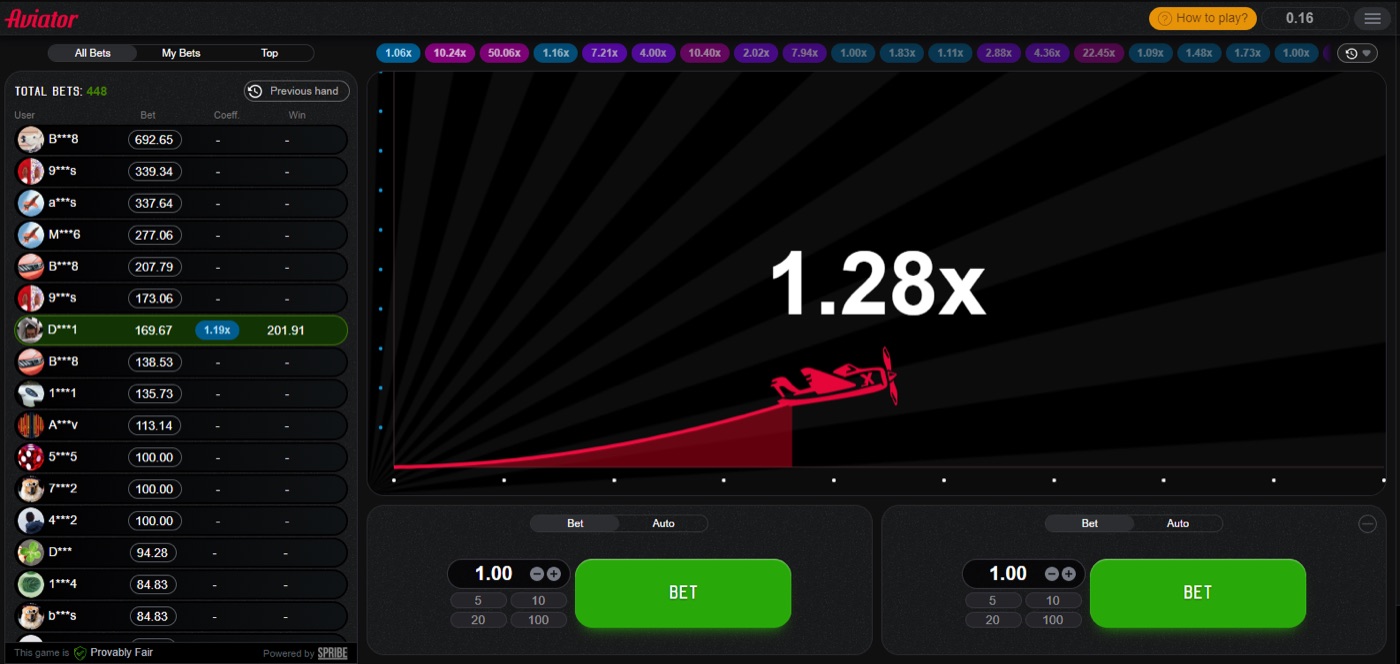
The plane in flight shows a multiplier that can end at any time.
Why Targets Do Not Beat Edge
Aviator has an RTP of 97% and a house edge of 3%. The expected value is -3% of the stake at every cash-out target.
At 1.2x, the round reaches the target with an 80.8% probability. At 10x, the probability is 9.7%. A higher target wins less often, while a lower target wins more often, but the edge remains.
| Cash-out target | Probability of reaching it | Expected value |
|---|---|---|
| 1.2x | 80.8% | -3% of stake |
| 1.5x | 64.7% | -3% of stake |
| 2x | 48.5% | -3% of stake |
| 5x | 19.4% | -3% of stake |
| 10x | 9.7% | -3% of stake |
| 100x | 0.97% | -3% of stake |
These figures explain why a 1.5x auto cash-out can produce many winning rounds without producing a positive long-term expectation. The cash-out target changes variance and the shape of results. It does not remove the edge.
A player comparing a crash game, multiplier, cash-out, stake or RTP may also encounter betway aviator happy hour, but a promotion or betting page cannot alter Aviator’s published probability model.
The two-bet approach also stays within the same model. One bet may cash out at 1.5x-2x while another aims at 5x-10x. The split changes how wins and losses arrive. It does not make either bet positive in expectation.
- Lower targets usually produce more frequent cash-outs.
- Higher targets produce fewer successful cash-outs.
- Splitting a stake changes variance between two bet panels.
- None of these choices changes the 3% house edge.
Martingale has the same problem. Doubling after each loss reaches 1,024 times the base stake after 10 losses. The system increases exposure after losses, but it cannot alter the independent crash probabilities.
Cash-Out And Latency
Aviator requires the cash-out request to reach the server before the crash. A cash-out time-out can result from latency or a slow device, according to explanations of player complaints.
The game works on desktop, tablet and mobile browsers. It was built for low bandwidth and budget devices, but a connection or device problem can still affect the timing of a request.
Auto Cash-Out does not wait for a player to press a button. It sends the preset instruction when the selected multiplier is reached. The instruction still has to reach the server before the crash.
- A displayed multiplier is not the same as a completed cash-out.
- A cash-out request must arrive before the crash.
- A slow connection can affect the request timing.
- Automation cannot recover a request that arrived too late.
Manual and automated play face this timing condition. Automation may reduce reaction time, but it does not guarantee execution at the displayed multiplier. The server result remains fixed before take-off, while the cash-out request remains a separate action.
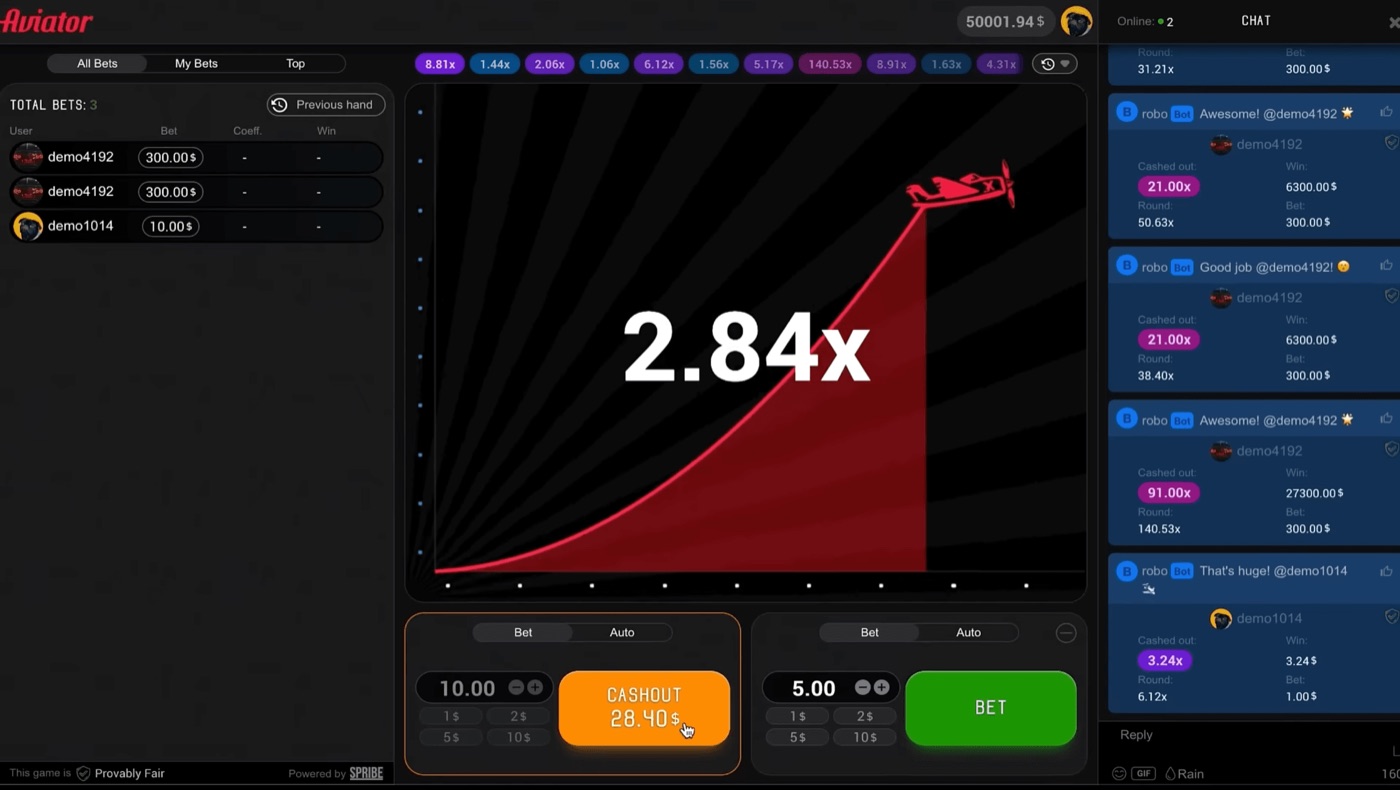
The interface can show live bets, chat and a cash-out at 28.40.
Patterns And Prediction Claims
Aviator fixes the crash point before take-off. The server reveals the inputs after the round, allowing the result to be checked with the in-game verification tool.
Independent rounds do not use the previous multiplier to set the next one. A high result does not require a low result next, and a series of low results does not make a high result due.
Auto-bet tools sometimes appear useful because they produce repeated data. The round history can show previous multipliers at the top of the interface. That history describes completed rounds; it does not alter the next crash point.
- Patterns do not change the next round’s probability.
- Graph analysis does not change the next round’s probability.
- A best time to play does not change the next round’s probability.
- A strategy chart PDF does not change the next round’s probability.
Third-party predictor apps do not provide a way around this process. Spribe has no standalone official Aviator app. The game runs inside an operator website or app, while apps called “Aviator” or “Aviator Predictor” on download platforms are third-party clones with virtual coins, ads or no-real-value disclaimers.
Telegram signal bots resell public mathematics. Version labels such as “Predictor v4.0”, “v8” and “v12” are marketing names, not Spribe products. Prediction is impossible because the crash point is committed by hash before the round.
Using Automation Carefully
Aviator’s Auto Bet can run 10-100 rounds, and the game provides stop-on-win and stop-on-loss controls. These controls can help define a session, but they cannot produce a mathematical advantage.
Demo mode is available through an operator demo or demo.spribe.io without registration. A player can use it to understand the two bet panels, Auto tabs, cash-out controls and round history without placing a real stake.
- Test the interface in demo mode before using real money.
- Choose the total session loss before setting the number of rounds.
- Keep the stake consistent with that session limit.
- Use stop-on-loss as an exit rule, not as a recovery system.
- Do not increase the stake after an automated loss.
Playing off-peak may provide a smoother connection, but it does not improve the odds. The same applies to a mobile device, desktop browser or app inside an operator’s platform. Convenience and connection quality are separate from RTP.
The operator determines some practical terms. Typical stakes range from about $0.10 to $100 per bet, but the available range depends on the operator. Win caps per round are also set by each operator, and Spribe has not published a maximum multiplier.
Automation is most useful as a mechanical instruction set. It can repeat a chosen action and apply a stopping condition. It cannot predict a crash, cancel the house edge or make a negative expected value positive.
Aviator FAQ
Aviator uses a 97% RTP and a 3% house edge. Its crash point is fixed before each round begins.
Auto-bet repeats instructions, while stop-on-loss limits when the automated sequence ends. Neither feature changes the independent probabilities of the rounds.
Can auto-bet beat Aviator?
No. Auto-bet changes how instructions are repeated across 10-100 rounds. It does not change the 97% RTP, the 3% house edge or the crash point.
What does stop-on-loss do?
Stop-on-loss ends the automated sequence after the selected loss condition is reached. It can limit further scheduled bets, but it cannot recover losses from completed rounds.
Is 1.5x a safe target?
No target removes risk. Aviator reaches 1.5x with a 64.7% probability, but the expected value remains -3% of the stake at that cash-out target.
Can a predictor identify the next crash?
No. The crash point is committed by a server hash before take-off, and the inputs are revealed after the round. Apps, bots and pattern charts cannot change that process.
Why did my cash-out time out?
The cash-out request must reach the server before the crash. Latency or a slow device can delay the request, so the displayed multiplier does not guarantee a completed cash-out.
Is there an official Aviator app?
Spribe has no standalone official Aviator app. Aviator runs inside an operator website or app, while third-party predictor and clone apps may use virtual coins or advertisements.