
Tracing Variable Spending on No-Sub Access Plans
OnlyFans access without a base subscription fee creates irregular spending that resists normal budgeting, because the cost arrives in fragments rather than one predictable charge. What follows traces those fragments: which purchase types inflate a zero-dollar page, where the platform hides the running total, and which budgeting techniques survive contact with a notification feed. BestOnlyFans publishes this as part of a running series on subscriber-side cost control. BestOnlyFans refreshes its rankings every month.
Someone browsing a free page makes dozens of micro-decisions, each trivial alone and each slightly easier to justify than the one before. Ranking sites tell you which pages exist; they do not tell you what you spent on them, and that gap is where budgets quietly fail. The BestOnlyFans method stays consistent across updates, so the same categories apply whether you check a page this month or next.
The Psychology of Pay-Per-View Purchasing
A single unlock rarely costs more than a takeaway coffee, so the mental accounting reserved for larger purchases never activates. The total only becomes visible at the end of the month, when the individual decisions can no longer be reconstructed.
- Anchoring — the free page sets a $0 reference point, so any unlock looks like a small deviation rather than a purchase.
- Frequency illusion — constant notifications make paid messages feel like normal traffic rather than offers requiring a decision.
- Loss aversion — limited-time unlocks frame skipping as losing something already available, not as saving money.
- Commitment escalation — a paid chat thread that has already cost $12 makes the next $8 reply feel like protecting an existing investment.
- Social proof — visible tip activity suggests that spending is the default behaviour rather than a choice.
None of these are exotic. They are standard microtransaction mechanics, and they work the same way in mobile games and delivery apps. The difference on a no-subscription page is that there is no fixed cost to compare against, so nothing anchors the month to a known figure.
Where Costs Accumulate on Complimentary Tiers
Complimentary tiers earn through volume rather than a single charge, and the vectors differ in how quickly they add up. Some arrive as isolated purchases; others chain together until a single evening produces five separate charges.
- Serial PPV message chains — sequential unlocks in one thread, each justified by the previous purchase.
- Premium clip unlocks — single items priced near the ceiling, often the largest individual line on a statement.
- Extended paid chat — conversations billed per message, where length rather than any single reply drives cost.
- Impulse tips during live streams — small, repeated, and timed to peak engagement.
- Custom content negotiations — quoted per request, with pricing agreed privately before delivery.
- Bundle purchase sequences — grouped unlocks presented as one offer but charged as several items.
PPV messages unlock up to $50, paid chat commonly runs $3 to $5 per message, and tips can reach $100. Individually each figure is modest. Combined across a month of daily browsing, they routinely exceed any fixed subscription the same subscriber would once have considered expensive.
Setting Hard Caps on Zero-Dollar Access
A budget that exists only as an intention will not survive a notification feed, so the cap has to be enforced by structure rather than willpower. The most reliable approach is to remove the ability to overspend rather than to promise restraint. Five mechanisms cover most situations.
- Single-load prepaid cards with no reload option bound the month to whatever was loaded at the start.
- Weekly budget periods instead of monthly ones shorten the feedback loop and expose overspending sooner.
- A 24-hour cooling rule for any unlock above $15 removes the urgency that limited-time offers depend on.
- A bookmarked spending log kept in a notes app makes the running total visible before a purchase rather than after.
- Automated balance alerts from the card issuer flag each charge as it clears, not at statement time.
Tip: set the cooling rule before you need it. A threshold decided in advance is enforceable; a threshold invented mid-purchase is not. If an unlock will not still look worthwhile tomorrow, it was never a purchase decision — it was a reaction.
Prepaid cards are not a complete solution because some creators accept several payment routes, but they raise enough friction to break automatic behaviour. Combined with a weekly period, most subscribers find the first overspend appears on day three rather than day twenty-eight. A short written rule kept beside the card also removes the need to negotiate with yourself in the moment.
Monthly Reconciliation and Spending Forensics
The card statement is the authoritative source; the platform’s own history is useful for categorising what each charge was for.
- Per-creator totals — spending concentrated on one or two pages is easier to manage than spending spread across ten.
- PPV type distribution — separate message chains from single clip unlocks to see which format drives cost.
- Day-of-week concentration — weekend spikes usually indicate impulse rather than planned spending.
- Unlock-to-regret ratio — the share of purchases you would not repeat is the clearest quality measure.
- Running average versus a fixed equivalent — comparing your monthly total to a $9.99 baseline shows what the free page actually costs.
One caution applies to the review process itself. If reconciliation involves opening messages to identify charges, you are browsing while auditing, which tends to produce new purchases. Export the history, close the app, and categorise afterwards from the file. The same discipline that applies to subscription accounting applies here: measure the period, then decide, but do not decide during measurement.
Platform Mechanics Behind Price Opacity
What the platform does not show is a running total, a monthly figure, or any projection based on your recent behaviour. That absence is not an accident of design; it is the natural consequence of a pay-per-item model where no single screen owns the aggregate.
| Display Pattern | User Experience | Mitigation Tactic |
|---|---|---|
| Individual unlock pricing | Price visible on each message, context invisible | Log every charge in a notes file the same day |
| Bundled sequence presentation | Several unlocks offered as one deal | Count the individual items and total them first |
| Frequent tip prompts | Repeated small asks normalise spending | Set a fixed weekly tip allowance |
| Per-message chat billing | Thread length drives cost, not single messages | Time-cap conversations rather than counting replies |
| No running total anywhere | Month-end figure arrives as a surprise | Reconcile weekly from the card statement |
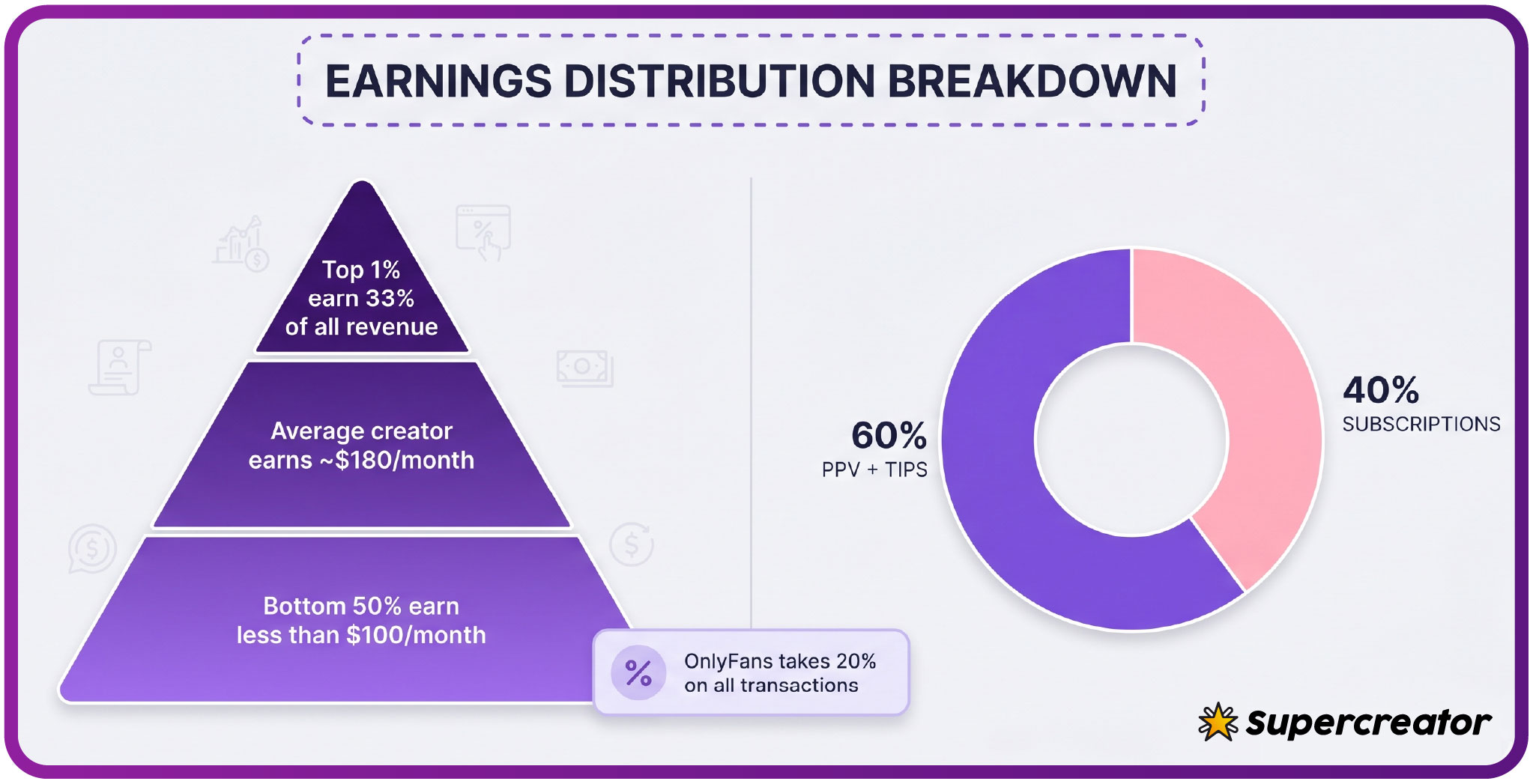
Creators also structure sequential offers to spread cost across several low-priced unlocks, which keeps each decision small while the cumulative figure grows. Because the platform charges a 20% fee and the creator keeps 80%, creators have a direct incentive to maximise the number of transactions rather than the size of any one.
Comparing Predictability: Complimentary Versus Fixed Subscriptions
The comparison is not about which is cheaper in general; it is about which produces a predictable number for your particular use pattern. A daily participant almost never does. The table below models four patterns.
| Monthly Use Pattern | Complimentary Tier Range | Fixed $9.99 Subscription |
|---|---|---|
| Light browsing (0-2 PPV unlocks) | $0 to roughly $12 | $9.99, fully predictable |
| Moderate engagement (3-7 unlocks) | Roughly $15 to $45 | $9.99 plus separate PPV charges |
| Heavy messaging, per-message billing | Roughly $40 to $90 | $9.99 plus chat costs, still variable |
| Daily active use across several pages | Roughly $70 to $150 | Multiple subscriptions at $4.99-$15 each |
The break-even calculation is simple: divide your average monthly PPV total by the subscription price of the page you browse most. If the result is above one, a paid subscription at $4.99 to $15 is the more predictable route, because a fixed charge stops the per-item decisions that generate the variable cost.
Predictability also has a second-order benefit. A fixed subscription converts spending into a single recurring charge that appears plainly on a statement, which makes it visible without any logging effort. A free page with heavy PPV use produces twenty or thirty separate lines, and that fragmentation is the main reason people lose track. Subscribers weighing options sometimes test a free subscription on only fans page before committing to a paid tier.
Long-Term Spending Trajectory Management
Recognising the stage helps, because the interventions that work in month one are not the ones that work in month five. Five stages show up repeatedly.
- Novelty exploration (month 1) — broad browsing across many pages, low totals but high transaction counts.
- Creator winnowing (month 2) — attention narrows to two or three pages, and per-creator spend rises.
- Routine formation (months 3-4) — a stable weekly pattern sets in, often unnoticed.
- Loyalty premium acceptance (month 5) — higher-priced unlocks feel justified by familiarity.
- Conversion or abandonment (month 6) — either a fixed subscription replaces the PPV pattern, or the page is dropped.
Familiarity lowers the perceived risk of each purchase, so the internal check weakens while the platform experience stays the same. The clearest early signal is a rising average unlock price rather than a rising number of unlocks, because it indicates the threshold itself has moved.
Two maintenance habits keep the trajectory flat. First, re-run the monthly reconciliation every four weeks without exception, even in months when spending was low. Second, review each creator page against its running total and drop any page whose cost no longer reflects the value you place on it. Neither habit takes long, and both prevent the slow drift that makes month six feel nothing like month one.

FAQ
Why does my monthly OnlyFans spending feel unpredictable?
Because the cost arrives as many separate small charges rather than one recurring fee, and no screen in the platform displays a running total. Memory reconstructs the month as a series of minor decisions, not as a sum, so the statement figure feels disconnected from anything you remember deciding.
Can I set a spending cap directly in OnlyFans?
Caps have to be enforced externally, usually through a prepaid card loaded with a fixed amount, a weekly budget period, or a cooling-off rule applied to unlocks above a set threshold.
How do I calculate whether PPV or fixed subscription is cheaper?
Total your pay-per-view spending for one month on a single page and divide by the subscription price you would otherwise pay.
What spending pattern typically emerges after six months?
Most subscribers move through novelty browsing, then narrow to a small set of pages, then settle into a stable routine with a slowly rising average unlock price. By month six the pattern usually resolves into a fixed subscription on the main page and a reduced set of pay-per-view purchases elsewhere.